

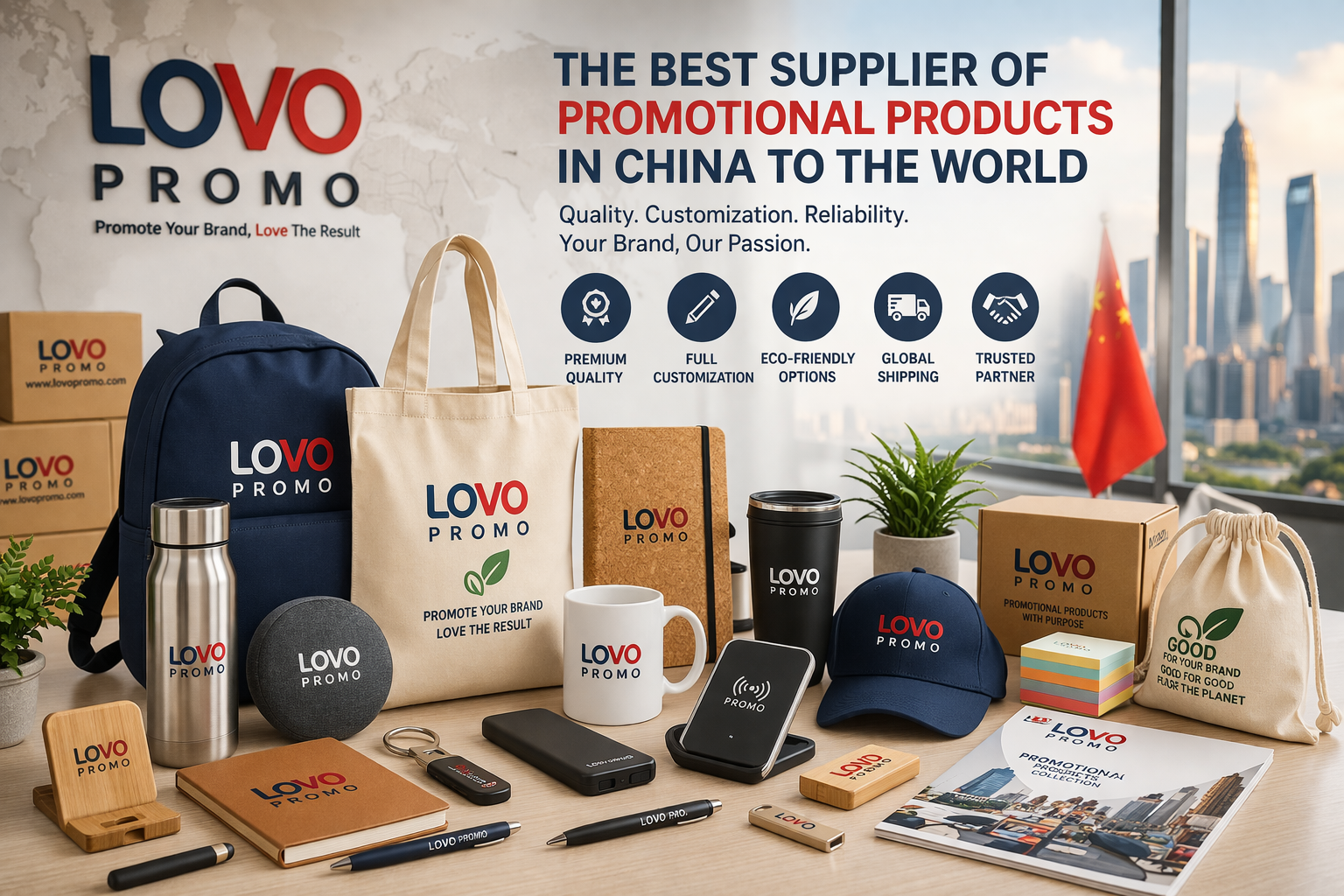
For decades, the narrative surrounding corporate gifts sourced from China has been dominated by a single, simplistic metric: volume. The perception was one of massive factories churning out millions of identical pens, lanyards, and mugs, prioritizing low cost over creativity. However, as the global business landscape pivots toward sustainability, digital integration, and emotional intelligence, the promotional products industry is undergoing a radical metamorphosis.
Observers at major industry hubs, particularly the RX Huabo Shenzhen Gift Fair and the Beijing International Gifts and Home Products Fair, have documented a significant shift in the 2026 season. No longer just a source of mass production, promotional products suppliers in China are emerging as innovators in smart technology, eco-conscious materials, and deeply personalized branding.
This article explores the seven major trends defining corporate gifting in 2026, illustrating how businesses can leverage these movements to transform simple promotional items into powerful tools for brand loyalty and employee engagement.
The Shift from Mass Production to Strategic Value for Promotional Products Suppliers in China
The most significant change in the industry is philosophical. Corporate buyers are moving away from viewing gifts as disposable marketing costs and instead treating them as strategic investments. According to data gathered from the spring 2026 exhibition season, including the massive gathering at the Shenzhen World Exhibition & Convention Center, there is a distinct move toward “scenario-based consumption.” This means products are no longer selected just for utility but for their ability to fit into specific lifestyle moments, such as hybrid work setups, outdoor adventures, or self-care routines . This evolution signals a move away from the “grab-and-go” promotional model toward a curated, experience-driven approach where the gift reflects a deep understanding of the recipient’s world.
The Rise of Eco-Conscious Manufacturing and the “Zero-Carbon” Aesthetic
Sustainability has transitioned from a niche marketing angle to a non-negotiable standard in the corporate world. For promotional products suppliers in China, 2026 represents a definitive break from disposable plastics. This is not merely about using recycled paper; it is about a holistic lifecycle approach that integrates environmental responsibility into the very fabric of the product.
Biodegradable Materials and Circular Economy Designs
Chinese suppliers are increasingly showcasing products made from agricultural waste and rapidly renewable resources. Exhibits at the Beijing礼品展 highlighted a surge in items crafted from bamboo, wheat straw fiber, and RPET (recycled polyethylene terephthalate). One of the most notable developments is the rise of “seed paper” products—items that can be planted in soil to grow herbs or flowers after their useful life as a promotional tool has ended .
This circular economy model resonates deeply with environmentally conscious consumers and helps corporations meet stringent Environmental, Social, and Governance (ESG) reporting requirements. Beyond the products themselves, the concept of the “zero-carbon aesthetic” is dominating packaging design, moving away from glossy laminates toward raw, tactile materials like kraft paper and soy-based inks .
The ESG Mandate Driving Procurement Decisions for Promotional Products Suppliers in China
The demand for sustainable options is no longer just a consumer preference; it is a boardroom mandate. Reports from suppliers like Ideal Promotional Products Suppliers in China indicate that global brands are becoming “immensely selective,” specifically requesting items that enhance brand visibility while strictly adhering to ESG standards .
Stainless steel tumblers, organic cotton tote bags, and biodegradable pens are now standard inventory items, but the trend is moving deeper. Companies are seeking supply chain transparency, wanting to know the carbon footprint of a specific giveaway.
Consequently, Chinese suppliers are investing in certifications and manufacturing processes that allow them to provide “sustainability certificates” alongside their products, turning a simple pen or bag into a verifiable statement of corporate responsibility.
Technology Integration and AI-Driven Smart Gifting
As technology becomes more intimate and wearable, corporate gifts are following suit. The 2026 Shenzhen Gift Fair spotlighted a definitive shift from traditional electronics to lifestyle-integrated smart devices. This goes beyond the standard power bank, moving into the realm of Augmented Reality (AR) and Artificial Intelligence (AI) companionship.
Wearables and Smart Lifestyle Products
According to industry reports from the Shenzhen fair, AI smart glasses are rapidly entering the mainstream gift and retail distribution channels . Once considered niche gadgets, these devices are now being offered by major suppliers alongside traditional housewares.
Beyond glasses, the market is seeing an influx of AI-enabled earbuds with real-time translation capabilities, companion robots for desk spaces, and intelligent toys designed for the families of employees. For the corporate buyer, these items signal a commitment to innovation. Gifting a pair of AI-enhanced glasses or a high-tech wellness band positions a brand as forward-thinking and aligned with the digital future.
This category also includes health tech, with brands like SKG showcasing smart wearables that monitor posture and relieve tension, catering specifically to the hybrid workforce suffering from “tech neck” and eye strain .
Digital Integration and Virtual Customization for Promotional Products Suppliers in China
The customization process itself has become a tech-driven experience. Leading Chinese suppliers are no longer just taking orders via email; they are deploying digital platforms that allow for “Print on Demand” (POD) and real-time visualization.
The concept of “one-piece customization” is no longer a logistical nightmare but a reality facilitated by AI-driven supply chains . Buyers can now upload a logo, see a photorealistic 3D rendering of the product, and approve a sample virtually within hours. Furthermore, digital gifting platforms are emerging as a key trend, allowing corporations to send virtual “gift vouchers” that recipients can redeem for a physical product of their choice. This solves the logistical issue of shipping heavy items internationally while still providing a tangible, branded touchpoint.
Wellness, Emotional Value, and the “Humanization” of B2B Gifting
The post-pandemic workplace has redefined the relationship between employer and employee. Corporate gifts in 2026 are heavily focused on psychological well-being, stress relief, and the creation of “emotional value.” The hard sell has been replaced by soft care, recognizing that an employee or client who feels emotionally valued is more loyal than one who receives a standard-issue clock.
The Explosion of the “Comfort” Economy
Data from both the Shenzhen and Beijing exhibitions confirm that “comfort” is a primary driver of purchasing decisions. Promotional Products Suppliers in China are reporting explosive growth in categories related to aroma therapy, massage devices, and weighted blankets.
Products such as premium essential oil diffusers, ergonomic neck massagers, and high-thread-count travel blankets are being positioned as ideal corporate gifts for employee appreciation days or wellness challenges.
The rationale is psychological: a gift that promotes rest and recovery signals that the company cares about the employee’s burnout levels, not just their output. This trend is particularly strong in the tech and finance sectors, where high-stress environments demand tangible tools for relaxation.
Scenario-Based Gifting for the Hybrid Workforce for Promotional Products Suppliers in China
With the normalization of hybrid work, the “office” is no longer a singular location. Promotional product trends are adapting to fit multiple “scenarios”. For the “Digital Nomad,” suppliers offer lightweight tech organizers, portable monitors, and high-quality audio equipment for Zoom calls.
For the “Home Sanctuary,” the focus is on loungewear, premium coffee brewing kits, and indoor plant growing systems. Chinese suppliers are increasingly skilled at bundling these items into curated boxes. Instead of a generic holiday hamper, a company might send a “Work from Home Wellness Kit” containing a bamboo laptop stand, a reusable vacuum-insulated mug, and a desk succulent. This contextual relevance dramatically increases the utility and appreciation of the gift.
Cultural Depth and Intellectual Property (IP) Integration
As the global market becomes saturated with generic goods, uniqueness becomes paramount. To combat “sameness,” Promotional Products Suppliers in China are leveraging deep cultural heritage and exclusive IP collaborations to offer products that tell a story. This move toward “cultural storytelling” elevates promotional products from commodities to collectibles.
The Modern Revival of Intangible Cultural Heritage
There is a rising trend in the “culturalization” of corporate gifts. Exhibitors at the Beijing Gift Fair showcased a significant revival of “Intangible Cultural Heritage” (ICH) items. However, these are not dusty antiques; they are modern interpretations of traditional crafts.
For example, embroidery techniques used for centuries are now being applied to laptop sleeves and branded corporate apparel. Porcelain and lacquerware are being reimagined as sleek, minimalist desk accessories .
For international brands looking to establish authenticity or celebrate a partnership with a Chinese firm, these culturally rich items serve as powerful symbols of respect and cross-cultural understanding. They provide a narrative that is far more engaging than a standard plastic pen.
Sports and Entertainment Crossover Appeal for Promotional Products Suppliers in China
With major global sporting events on the horizon, including the 2026 FIFA World Cup, the intersection of sports IP and promotional products is a booming sector. Chinese suppliers are collaborating with major leagues and clubs to offer officially licensed merchandise for corporate giveaways.
This allows businesses to tap into the emotional fervor of sports fandom. A tech company might give away co-branded Bluetooth speakers featuring the colors of a national football team, or a bank might offer limited-edition mascot plush toys to young clients.
This crossover allows corporate gifts to function as “social currency,” items that recipients are excited to show off and share on social media rather than hiding in a drawer.
Bespoke Customization and the Decline of the “One-Size-Fits-All” Model
The era of bulk uniformity is ending. In 2026, the demand for personalization has reached a fever pitch, driven by social media and the expectation of individual treatment.
Chinese suppliers, known for their flexible manufacturing (flex-factory) capabilities, are uniquely positioned to meet this demand for high-variability, low-volume orders.
Low MOQ and High Mixity
Historically, one of the biggest barriers to sourcing from China was the high Minimum Order Quantity (MOQ). However, the competitive landscape has forced a change. Responding to the needs of Small and Medium Enterprises (SMEs) and startups, many factories now offer Low MOQs and “one-piece customization” services.
This is facilitated by advanced digital printing techniques that do not require expensive molds or setup fees. A company can now order just fifty bespoke Bluetooth speakers with a custom colorway and logo engraving, whereas five years ago, they would have been forced to buy five thousand.
This agility allows for hyper-targeted marketing campaigns a sales team can have a product tailored to a specific region or a specific client’s brand colors without massive waste or expense.
Personalization Beyond the Logo for Promotional Products Suppliers in China
Customization in 2026 goes far beyond silk-screening a logo onto a surface. It involves co-creation. Suppliers are offering services where they alter the formula of a scented candle, change the flavor profile of a gourmet snack box, or select the cover material of a journal based on the recipient’s profile.
For high-value clients, “Name-Dropping” is back in style but with a modern twist. Laser engraving has become so sophisticated that names can be etched in elegant, brand-specific fonts onto metal pens, leather portfolios, and even smartphone cases.
This level of detail creates a sense of “exclusivity” that mass-produced items simply cannot replicate. It tells the recipient, “This gift was made for you,” significantly increasing the emotional impact of the gesture.
Premiumization of Everyday Items
Another dominant trend observed by market analysts is the “premiumization” of utilitarian goods. While tech gadgets and wellness items are rising, the humble “daily use” item has not disappeared; it has simply gotten a luxurious upgrade.
The focus is on marrying high functionality with high aesthetics, often referred to as the “BIFL” (Buy It For Life) mentality applied to promotion.
The Evolution of the Stainless Steel Revolution for Promotional Products Suppliers in China
Stainless steel drinkware is a classic example of this premiumization. Rather than basic, single-walled bottles, suppliers are now showcasing vacuum-insulated mugs with advanced ceramic linings, self-cleaning capabilities, and sophisticated powder-coated finishes that resist scratching. Similarly, the simple umbrella has been reinvented.
Suppliers are offering wind-resistant, fiberglass-framed umbrellas with auto-open/close mechanisms and wooden handles that look like they belong in a high-end department store. By upgrading these everyday items to a luxury standard, the corporate gift suggests an attention to detail and quality that reflects directly on the brand giving it away.
The Rise of Premium Desk Accessories
As the home office endures, the desk has become a sacred space. Chinese suppliers are pivoting away from cheap plastic pen holders toward sculptural desk organizers made of concrete, silicone, real wood, and aluminum. Wireless charging pads are being integrated into mouse pads and desk mats made from recycled ocean plastics.
These items are visually appealing and often end up in the background of video calls, providing passive brand exposure to a wide audience. A sleek, minimalist desk lamp or a high-quality mechanical keyboard has become a coveted corporate gift for knowledge workers, blending utility with a modern design sensibility that employees are proud to display.
The Future Outlook for Corporate Sourcing from China
As the 2026 trade show season progresses, it is clear that the relationship between global brands and Promotional Products Suppliers in China has matured. The industry has successfully pivoted from being a low-cost provider to a strategic innovation partner.
The convergence of AI, sustainability, and emotional design is creating a new category of promotional products that are functional, ethical, and deeply personal. For the corporate buyer, the strategy moving forward should focus on narrative and precision.
The days of ordering ten thousand of the same item for the whole company are fading. The future is a portfolio of gifts: high-tech gadgets for the early adopters, eco-friendly wellness kits for the remote team, and cultural or sports memorabilia for long-standing clients.
The data from the spring 2026 exhibitions indicates that buyers who embrace these trends—specifically low-MOQ customization, ESG compliance, and scenario-based product curation will see higher engagement rates and a stronger Return on Investment (ROI) on their gifting budgets. Promotional Products Suppliers in China have proven they are ready to move beyond the logo.
The challenge and opportunity for marketing professionals now lie in moving beyond the transaction to deliver a gift that truly feels like a thoughtful gesture. As the lines between consumer electronics, home décor, and promotional merchandise continue to blur, the possibilities for creative, impactful corporate gifting have never been broader.