

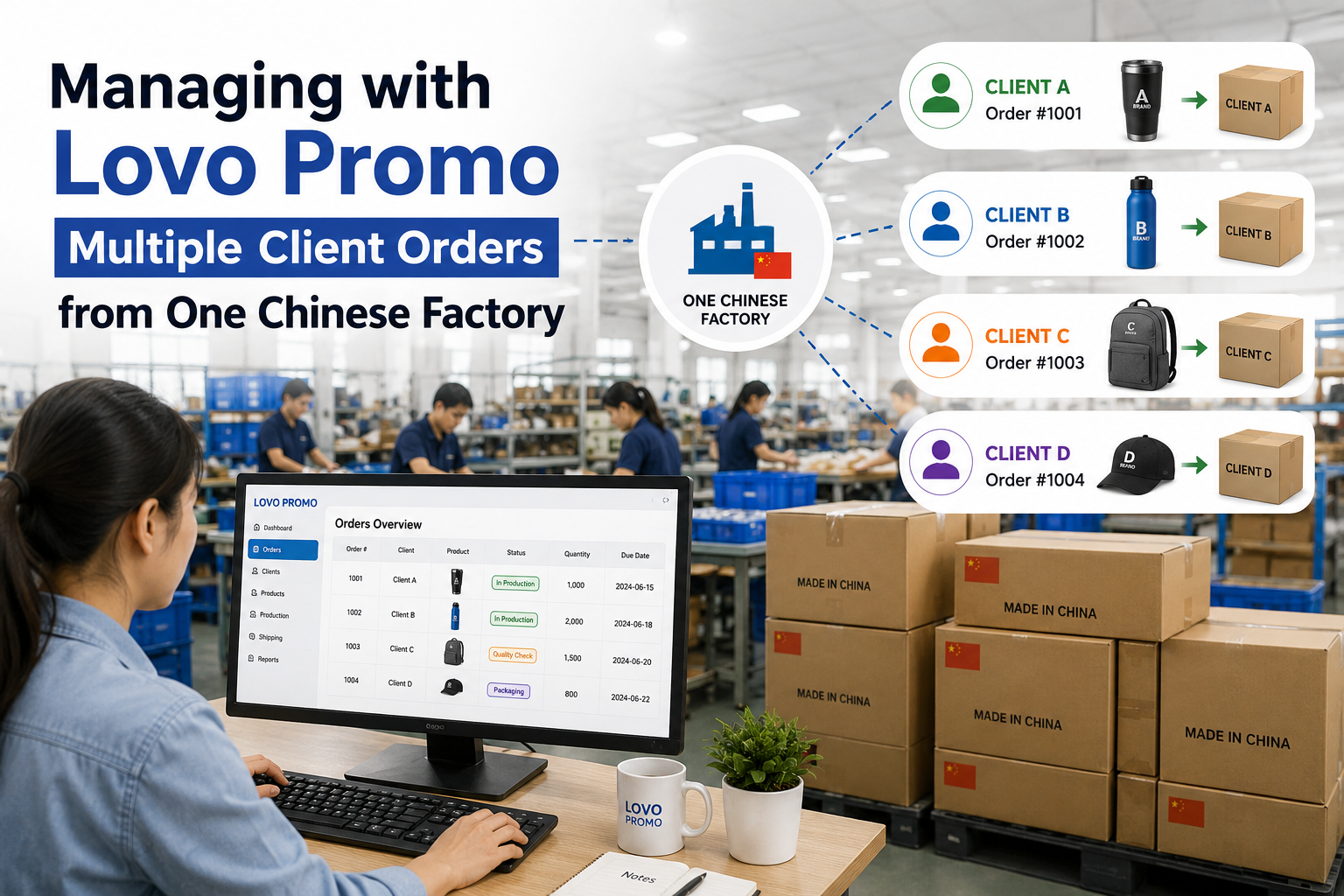
For marketing agencies and promotional products distributors, juggling several client campaigns simultaneously is a familiar reality. When sourcing from a promotional products supplier in China, the complexity increases significantly. However, managing this process efficiently is the key to scaling a business without scaling operational chaos. A professional who masters the art of consolidating multiple client orders through a single factory gains a substantial competitive advantage in terms of cost, speed, and reliability.
This guide explores how professionals can streamline the handling of multiple client orders from a single source, using Lovo Promo as a case study for best practices in consolidation, communication, and quality assurance. The strategies outlined here apply broadly to any supplier relationship but are particularly relevant for those working with high-volume Chinese manufacturers.
The Challenge of High Volume Client Management
Distributors often face a specific bottleneck when dealing with overseas suppliers. The supplier typically treats every order as an isolated event, which leads to missed opportunities for shipping discounts, confusion in warehouse receiving, and delayed timelines. For a professional managing five or ten different end clients, receiving ten different packages on ten different days is a logistical nightmare that wastes time and money.
The root of the problem lies in communication silos. When a professional sends separate emails for each client order, the factory’s sales team may assign each order to a different production planner. Those planners do not talk to each other, and the result is fragmented production runs that could have been combined. A professional who recognizes this early can restructure the entire workflow to avoid these inefficiencies.
Why Consolidation Is the Ultimate Goal
When a buyer manages multiple orders, the primary objective is consolidation. Instead of shipping custom pens for Client A on Monday, notebooks for Client B on Tuesday, and bags for Client C on Wednesday, a skilled project manager pushes for a single weekly shipment. This approach transforms chaos into order and creates measurable savings.
Freight savings represent the most immediate benefit. Consolidation turns ten small air shipments into one large air or sea shipment, and the cost per kilogram drops dramatically at higher volumes. A professional who consolidates routinely can pass some of these savings back to clients while keeping the rest as profit margin.
Receiving efficiency also improves dramatically. It is far easier for a warehouse manager to open one large carton pallet than fifty small poly mailers. Each package opened represents labor time, and labor time is money. A single consolidated shipment reduces receiving labor by as much as eighty percent compared to multiple small shipments arriving on different days.
Inventory control becomes more reliable as well. When all orders arrive together, the professional can inspect all quality control samples against a master order sheet before distributing products to end clients. This allows for batch corrections if a problem is found, rather than discovering the same defect repeatedly across multiple late arriving shipments.
Establishing a Centralized Workflow with Lovo Promo
Working with a supplier like Lovo Promo requires a structured workflow that the professional designs and enforces. The professional acts as a general contractor, while Lovo Promo acts as the manufacturing subcontractor. This relationship works best when expectations are documented and shared before any production begins.
A professional does not send five separate emails for five separate orders. Instead, they maintain a master production schedule that is shared with the factory liaison in a readable format like a spreadsheet or a shared online document. This schedule becomes the single source of truth for all parties involved.
Batch Processing Artwork for Multiple Clients
One of the most time consuming aspects of managing multiple orders is the back and forth over artwork files. A professional who sends logo files one at a time creates unnecessary work for themselves and for the supplier. The smarter approach is batch processing.
All vector logos in AI or PDF formats for different clients are sent in one compressed folder. The supplier receives clear instructions to route each file to the specific production line responsible for that client’s products. This requires naming conventions that make sense to someone who does not speak the professional’s native language.
The professional also includes a simple spreadsheet that maps each file name to a purchase order number, a client name, and a specific product line. This extra step takes fifteen minutes but can save hours of email clarification later. Lovo Promo’s art department can then work through all files in a single session rather than stopping and starting as new requests trickle in.
Unified Timelines and Production Slots
Negotiating a single production slot for multiple orders is a skill that separates average project managers from exceptional ones. The professional approaches Lovo Promo with a request to run all mug orders on a specific production line during a specific week and all bag orders on another line during the following week.
This approach benefits both parties. The factory gains efficiency by not changing over its machinery repeatedly, and the professional gains predictability because all similar products move through production together. If the professional needs to check on progress, one phone call answers the status of all mug orders rather than five separate inquiries.
The professional also builds buffer time into the unified timeline. Chinese factories often run at maximum capacity, and delays happen. By adding two to three extra days between the promised completion date and the actual ship date, the professional creates room for last minute corrections without disappointing end clients.
Utilizing a Dedicated Account Manager
To avoid the telephone game where one factory representative does not know what another representative is doing, the professional insists on a single point of contact at Lovo Promo. This dedicated account manager becomes responsible for every order placed by that professional, regardless of which end client the order serves.
The benefits of a single point of contact cannot be overstated. All communication regarding Client A’s defects and Client B’s shipping address goes through one person. This reduces error rates significantly compared to using a generic customer service email address where different representatives answer each message.
The professional trains this account manager by providing clear documentation about how orders should be handled. Over time, the account manager learns the professional’s preferences without needing to ask repetitive questions. This relationship becomes more valuable than any single order because it enables speed and trust.
Weekly status reports are another tool the professional uses. Every Friday, Lovo Promo sends a consolidated spreadsheet listing each client order with its current status. Client Order One might show as complete and awaiting shipping. Client Order Two might show as currently in printing. Client Order Three might show raw materials received. This single report replaces five separate status checks and gives the professional a complete picture at a glance.
Strategies for Efficient Order Consolidation
Once the orders are in production, the professional’s focus shifts to the exit strategy. Getting products out of the Chinese factory and into the hands of end users requires careful planning, especially when multiple clients have different deadlines and different budgets for shipping.
Mixing Sea and Air Freight
A sophisticated strategy involves splitting the shipment based on urgency and volume. Not every client needs their products tomorrow, and not every client wants to pay for expensive air freight. The professional segments orders into categories and applies the appropriate shipping method to each.
For urgent needs, air freight is the answer. If Client B needs five hundred stress relievers for a trade show next week, those products are air shipped immediately. The professional requests that Lovo Promo labels these boxes in bright red or with a specific rush sticker so they can be identified easily at the warehouse. The professional also confirms that the air shipment documentation clearly separates these items from slower moving goods.
For stock orders that are not time sensitive, sea freight is the better choice. The remaining ninety percent of orders, including pens, lanyards, and bulk stock items, go via sea freight. This saves the client money and consolidates the receiving process at the local warehouse. A forty foot container can hold an enormous quantity of promotional products, and the cost per unit drops to pennies when shipped by sea.
The professional communicates these decisions to end clients early in the process. A client who knows that their order will take six weeks by sea can plan accordingly. A client who needs two week delivery can pay the premium for air freight without feeling surprised.
Repackaging and Co-Loading at the Factory
Sometimes the Chinese supplier will ship individual cartons for each order, which defeats the purpose of consolidation. The professional prevents this by instructing Lovo Promo to perform co loading at the factory before any shipment leaves the building.
Co loading means combining products from multiple client orders into larger outer cartons or onto shared pallets. For a distributor with its own warehouse, the outer cartons must not simply say Client A or Client B on the inside packing list alone. The label on the outside must clearly state that the carton contains products for multiple clients. A typical label might read Carton One of Ten Contains Client A with five hundred pens and Client B with two hundred mugs.
This labeling allows the warehouse to receive the shipment and immediately know which cartons need to be opened and sorted. Without clear labeling, workers must open every carton to see what is inside, which wastes time and increases the risk of mixing up products.
Palletization is another key step. The professional requests that all orders bound for the same destination country be loaded onto the same pallet, shrink wrapped, and banded together. A single pallet moving through the freight system is much harder to lose or delay than a dozen loose cartons. The professional also asks for photographs of the packed pallets before they are sealed, providing visual confirmation that the consolidation was done correctly.
Maintaining Quality Control Across Different Specifications
Quality standards vary dramatically by client. A luxury real estate firm demanding high end metal pens has different tolerances than a school district ordering plastic frisbees. Managing this variance through a single Chinese factory requires a documented matrix that leaves nothing to interpretation.
The Tolerance Matrix Document
Before any production begins, the professional provides Lovo Promo with a document detailing acceptable quality limits for each client. This tolerance matrix becomes part of the purchase order and is referenced during quality control inspections.
For a luxury client, the professional specifies zero tolerance for color mismatch and requires one hundred percent inspection for logo alignment. Every pen in that order must meet the highest standard, and any pen that does not meet that standard is rejected immediately.
For a budget client, the professional might allow plus or minus ten percent color variance and accept minor surface scratches that are not visible from a normal viewing distance. These tolerances reflect the price point and the client’s expectations. The professional documents these differences so the factory knows exactly which products require extra care.
For a standard promotional client, the professional specifies commercial quality. This means the product looks good at a glance but does not need to survive microscopic inspection. Most promotional products fall into this category, and documenting it as such prevents the factory from wasting time on unnecessary perfection.
By listing these tolerances in a table within the purchase order, the factory knows that the same production run of pens must be segregated. Luxury pens go to the quality assurance line for individual inspection, while bulk pens go straight to packing. The professional avoids paying luxury inspection prices for budget products.
Pre Shipment Video Verification
Since the professional cannot always fly to China for every order, they request a pre shipment video call with Lovo Promo’s quality assurance manager. This live verification provides real time evidence that products meet specifications before they leave the factory.
During the call, the Lovo Promo quality assurance manager holds up random samples from Client A, Client B, and Client C’s batches directly to the camera. The professional checks the stitching on bags, the print adhesion on mugs, the color accuracy on pens, and any other attribute that matters to that specific client.
The destruction test is another useful tool. For stress items like bags or lanyards, the professional asks to see a destruction test on video. The factory worker pulls the bag strap with force until it either holds or breaks. A strap that breaks under moderate pressure indicates a serious quality problem that would lead to client complaints and returns. A strap that holds strong gives the professional confidence to ship the order.
The professional records these video calls or takes screenshots of key moments. If a client later complains about quality, the professional has evidence that the product was approved before shipping. This documentation protects the professional’s relationship with both the client and the supplier.
Logistics and Customs Handling for Mixed Orders
Shipping consolidated orders can complicate customs clearance because mixed goods attract more attention from inspectors. A smart professional preempts border issues by preparing documentation that leaves no room for confusion or delay.
The Packing List Dilemma Solved
A standard packing list says one hundred cartons of promotional products. A consolidated packing list must be an exploded view that shows exactly what is inside every carton. Customs officials who see a vague packing list may detain the shipment for hours or days while they request clarification.
The professional ensures Lovo Promo issues a commercial invoice with detailed line items. Line Item One might show ten cartons of silicone bracelets for Client A with the appropriate HS code and a declared value of five hundred dollars. Line Item Two might show fifteen cartons of cotton t shirts for Client B with a different HS code and a value of two thousand dollars.
This level of detail serves two purposes. First, it allows customs to quickly classify and assess duties on each product category. Second, it protects the professional if one product category is found to violate import regulations. Only the problematic cartons are seized rather than the entire consolidated shipment.
The professional also confirms that the HS codes are accurate for each product. Using the wrong code can lead to fines or delayed shipments. When in doubt, the professional consults a customs broker before finalizing the documentation.
DDP Versus FOB for Multiple Clients
The professional must decide who pays the duty and who handles the freight. Two common options are Delivered Duty Paid and Free on Board, and each has advantages and disadvantages when managing multiple client orders.
Delivered Duty Paid means Lovo Promo handles everything from factory floor to the professional’s door. The supplier pays all freight costs, all insurance, and all customs duties. This is the easiest option for the professional because there is only one invoice to pay and no logistics to manage. However, Delivered Duty Paid requires the supplier to know the import regulations for all mixed goods, which can be risky for commodities like batteries or food contact items. If Lovo Promo makes a mistake in classification, the professional’s shipment is delayed and the supplier may not be responsive to fix it quickly.
Free on Board means the professional hires a freight forwarder to handle the shipment from the Chinese port to the final destination. This is the safer option for complex consolidated orders because the forwarder specializes in deconsolidation. Upon arrival, the forwarder splits the master pallet into smaller local courier deliveries for each end client. The professional pays the duties directly and knows exactly where every package is at every moment.
Many experienced professionals choose Free on Board for multi client orders precisely because of this control. The slightly higher management effort is worth the peace of mind that comes from knowing a licensed freight forwarder is handling the complexities of customs clearance.
Avoiding Common Pitfalls in Multi Client Sourcing
Even with a great supplier like Lovo Promo, mistakes happen. The key to success is anticipation rather than reaction. A professional who knows the common pitfalls can build safeguards into the process before problems occur.
The Mixed Up Inventory Error
One of the most frustrating errors occurs when Client A’s branded pens accidentally get packed into Client B’s box of notebooks. This error is invisible until the end client opens the box and finds the wrong products. By then, it is too late to fix without expensive rush production and air freight.
The professional prevents this error by requiring carton stuffing photos. Before Lovo Promo seals the last carton, a worker takes a photograph showing the specific product going into the specific box labeled for the specific client. The professional reviews these photos before giving final approval to seal and ship.
The cost of this requirement is nearly zero. Every smartphone has a camera, and sending photos takes seconds. The value is immense because catching a packing error at the factory costs nothing to fix, while catching it at the client’s door costs hundreds or thousands of dollars in replacement product and expedited shipping.
Communication Time Zone Slippage
China operates on Beijing time, which is twelve or thirteen hours ahead of Eastern Standard Time depending on daylight saving. If the professional emails Lovo Promo at five PM Eastern Time, the factory is asleep and will not see the message until the next morning in China. By the time the professional wakes up, the factory may have already made a decision based on incomplete information.
The professional solves this problem with a twenty four hour rule. All approvals for client colors, artwork, and specifications are requested at least forty eight hours before the actual production deadline. This buffer accounts for the natural lag in the response cycle.
The professional also uses shared calendars and scheduling tools that show working hours in both time zones. When a deadline is critical, the professional schedules a phone call during the overlap of working hours, which occurs in the evening in China and the morning in the United States. A ten minute phone call can resolve questions that would take three days to answer by email.
Creating a Long Term Scalable System
Managing multiple clients is not about working harder on each individual order. It is about building a system that works the same way every time, reducing cognitive load and freeing the professional to focus on sales and client relationships rather than firefighting.
The Quarterly Business Review
Once every three months, the professional sits down virtually with the management team at Lovo Promo. This is not a social call. It is a structured review of the previous quarter’s performance and a planning session for the quarter ahead.
The professional brings data to the review. How many orders were placed? How many were on time? How many contained defects? What was the error rate per client order? Was it two percent or ten percent? These numbers tell the story of the relationship and identify areas for improvement.
The professional also brings requests for process improvements. Perhaps they want a dedicated production line for agency priority orders. Perhaps they want faster sampling for repeat clients. Perhaps they want a specific person assigned to handle all artwork revisions. These requests are negotiated during the quarterly review rather than raised as emergencies in the middle of a production run.
The Standard Operating Procedures Document
The ultimate tool for scaling is a shared Standard Operating Procedures document titled How to Handle Our Orders. This document tells Lovo Promo exactly how to pack, label, invoice, and ship for any client without asking repetitive questions.
The document includes specific instructions for labeling outer cartons, naming artwork files, sending weekly status reports, conducting video quality checks, and handling returns or defects. Every instruction is written in clear, simple English that translates well for a non native speaker.
The professional updates this document whenever a new lesson is learned. A mistake that happened once is documented so it never happens again. Over time, the document becomes a comprehensive manual that allows a new account manager at Lovo Promo to step in and handle orders correctly from day one.
By mastering these logistics of consolidation, quality segregation, and customs planning, a professional transforms the chaos of multiple orders into a streamlined and profitable machine. Working with a promotional products supplier in China like Lovo Promo becomes not just a cost saving measure but a genuine competitive advantage in the promotional products industry. The professional who invests the time to build these systems today will reap the rewards of efficiency and client trust for years to come.